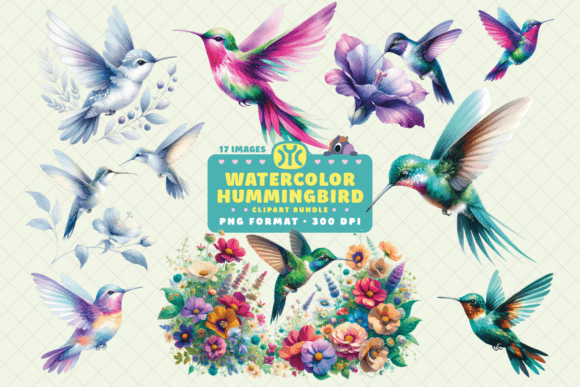
Watercolor Hummingbird Clipart
Watercolor hummingbird clipart has quietly become a go-to asset for designers, small business owners, and content creators who want to add a touch of nature, movement, and soft elegance to their work. Unlike rigid vector icons or flat illustrations, these hand-painted-style images carry the organic feel of real watercolor washes—gradients that bleed, edges that softly fade, and color layers that feel alive. For anyone building brand identity, designing packaging, or crafting social media visuals, this clipart offers a shortcut to a bespoke, artistic look without needing to commission original paintings.
The visual personality of watercolor hummingbird clipart is delicate yet energetic. Hummingbirds are naturally dynamic—hovering, darting, wings blurred—and the watercolor medium amplifies that sense of motion. The transparency and blending of pigments create a dreamy, almost ethereal quality. You'll often find soft greens, pinks, blues, and yellows, sometimes with splatter effects or loose ink outlines. This style sits somewhere between realistic botanical art and abstract expressionism, which makes it versatile for both whimsical and sophisticated projects.
Where Watercolor Hummingbird Clipart Makes the Biggest Impact
This is not a one-trick piece of design assets. The applications span digital and print, personal and commercial. If you run a lifestyle blog or a wellness brand, hummingbird clipart can become a recurring motif in your headers, blog graphics, or even your logo. The watercolor effect softens the overall aesthetic, lending a handcrafted feel that resonates with audiences tired of sterile, corporate visuals.
For packaging design, think tea boxes, organic skincare labels, artisanal honey jars, or greeting cards. The hummingbird adds a story element—nature, lightness, sweetness—while the watercolor texture communicates quality and craftsmanship. Similarly, in editorial design (magazines, book covers, or brochures), a well-placed hummingbird clipart can break up large blocks of text and guide the reader's eye without overpowering the layout.
In the web design and social media graphics realm, these clipart pieces work beautifully as hero images, background textures, or accent elements. Because watercolor hummingbird clipart often comes in PNG or high-resolution formats with transparent backgrounds, you can layer it over solid colors, gradients, or photographs. For a blog post about spring or mindfulness, a single hummingbird perched on a branch can set the tone before anyone reads a word. Instagram stories, Pinterest pins, and Facebook covers all benefit from this kind of custom-looking imagery.
How This Clipart Influences Brand Perception and Engagement
One of the biggest challenges for small businesses and creators is establishing a consistent brand identity without a huge budget. Watercolor hummingbird clipart can become a signature element—a visual shorthand for your values. Because the style is organic and artistic, it immediately signals creativity, attention to detail, and a human touch. Audiences perceive brands using such imagery as more approachable and trustworthy.
From a visual hierarchy perspective, soft watercolor assets draw the eye gently. They don't scream for attention like neon or high-contrast designs. Instead, they invite viewers to pause and explore. This is particularly valuable for branding projects aimed at products like tea, scented candles, yoga studios, or children's books. The clipart also provides a natural anchor for font pairing. A delicate script font combined with a watercolor hummingbird can feel instantly cohesive and premium. Or you can pair it with a clean sans serif font for a modern, minimal look that still retains warmth.
Consistency matters. When you reuse the same hummingbird clipart across your website, product labels, and email headers, you build a recognizable visual language. Over time, that repetition reinforces brand recall. The key is to use the clipart intentionally—not as a one-off decoration but as part of a broader design system that includes your typeface, color palette, and layout grid.
Practical Guidance for Choosing and Using Watercolor Hummingbird Clipart
Before you download the first set you find, consider your project's overall tone. Watercolor hummingbird clipart comes in many sub-styles: some are highly detailed with realistic feather textures and smooth gradients; others are more minimalist and abstract with loose brush strokes and limited colors. For a premium font-based logo or a modern typography layout, a simpler clipart works better—it won't compete with the text. For a large-format print like a poster or a wall art piece, you can afford more complexity and detail.
Test font pairings early. Since this clipart is often colorful and soft, pair it with fonts that have a contrasting weight or structure. A bold serif font can ground the airy watercolor, while a light handwritten font can enhance the whimsy. Try a few combinations on a mockup: a social media square with the hummingbird placed to one side and the headline on the other. Adjust the opacity or scale of the clipart until it feels balanced. Sometimes you only need a tiny hummingbird as an accent—overusing it can dilute the impact.
Review included styles and formats. Commercial use rights vary. If you are creating products for sale—ebooks, templates, physical goods—make sure the license covers commercial font usage (or in this case, commercial clipart usage). Look for sets that offer multiple file types: PNG (with transparent background), SVG (for scalability), and maybe AI or EPS (for further editing). High resolution (300 DPI or more) is essential for print projects; 72 DPI may suffice for web use but check the size.
Readability considerations are more about the overall layout than the clipart itself. Because watercolor hummingbird clipart has soft edges, it may not contrast well with similarly light backgrounds. If you place it on a white or pale pastel background, the image might fade into nothing. Use a darker background (deep green, navy, warm charcoal) to make the watercolor pop, or add a subtle drop shadow to separate it. For text overlays, ensure there's enough contrast between the clipart area and the lettering. A semi-transparent overlay behind the text can help.
Real-World Examples and Design Observations
I've seen watercolor hummingbird clipart used effectively in an Etsy shop for printable wedding stationery. The shop owner used a single hummingbird illustration as a watermark on the RSVP cards and a larger version on the save-the-date. The clipart tied everything together without needing a full custom illustration. Another example: a small-batch perfume brand used a hummingbird as the central motif on their product labels, combined with a soft script font. The result felt luxurious but not stiff—perfect for their natural, floral-inspired scents.
On the flip side, I've also seen misuse. A local cafe used a highly detailed watercolor hummingbird as a background for their menu board, but paired it with an overly ornate display font. The two competed, and readability suffered. The lesson: let the clipart breathe. If the hummingbird is complex, keep the font simple and the text short. If you have a lot of text (like a blog post header), use the clipart as a small decorative element rather than a full background.
For logo design, watercolor hummingbird clipart can be a great starting point for a mascot or icon, but be cautious about scalability. A logo needs to work at very small sizes (like a favicon or social media avatar). A watercolor image might lose its detail when shrunk. Consider a simplified version or a flat vector alternative for tiny applications, while using the watercolor version for larger branding touchpoints.
Finally, think about brand identity as a story. Watercolor hummingbird clipart brings narrative potential—the hummingbird itself is a symbol of joy, resilience, and energy. If your brand aligns with those values (or you want your audience to feel that way), this clipart can be more than decoration; it becomes part of your brand's emotional language. Use it consistently across your packaging design, your web design, your social media graphics, and even your editorial design projects. Over time, your audience will associate that delicate watercolor look with your unique voice.